
01 · Mar–Apr 2026Live
Agentic Payments Research
Six months of primary research into how AI agents pay each other over crypto rails, and an honest account of what shipped.
- Primary-source research
- Obsidian vault
- Claude Code
- HTML Field Manual
- +2
Sep 2026 · 15 projects · 6 live
Business development and ecosystem operator. Six months of primary research on agentic payments, tokenization, and what institutions actually do on Solana.
Each one written up as what I built, what I learned, and where it cut against my own view. All directed, none hand-coded.
Six months of primary research into how AI agents pay each other over crypto rails, and an honest account of what shipped.
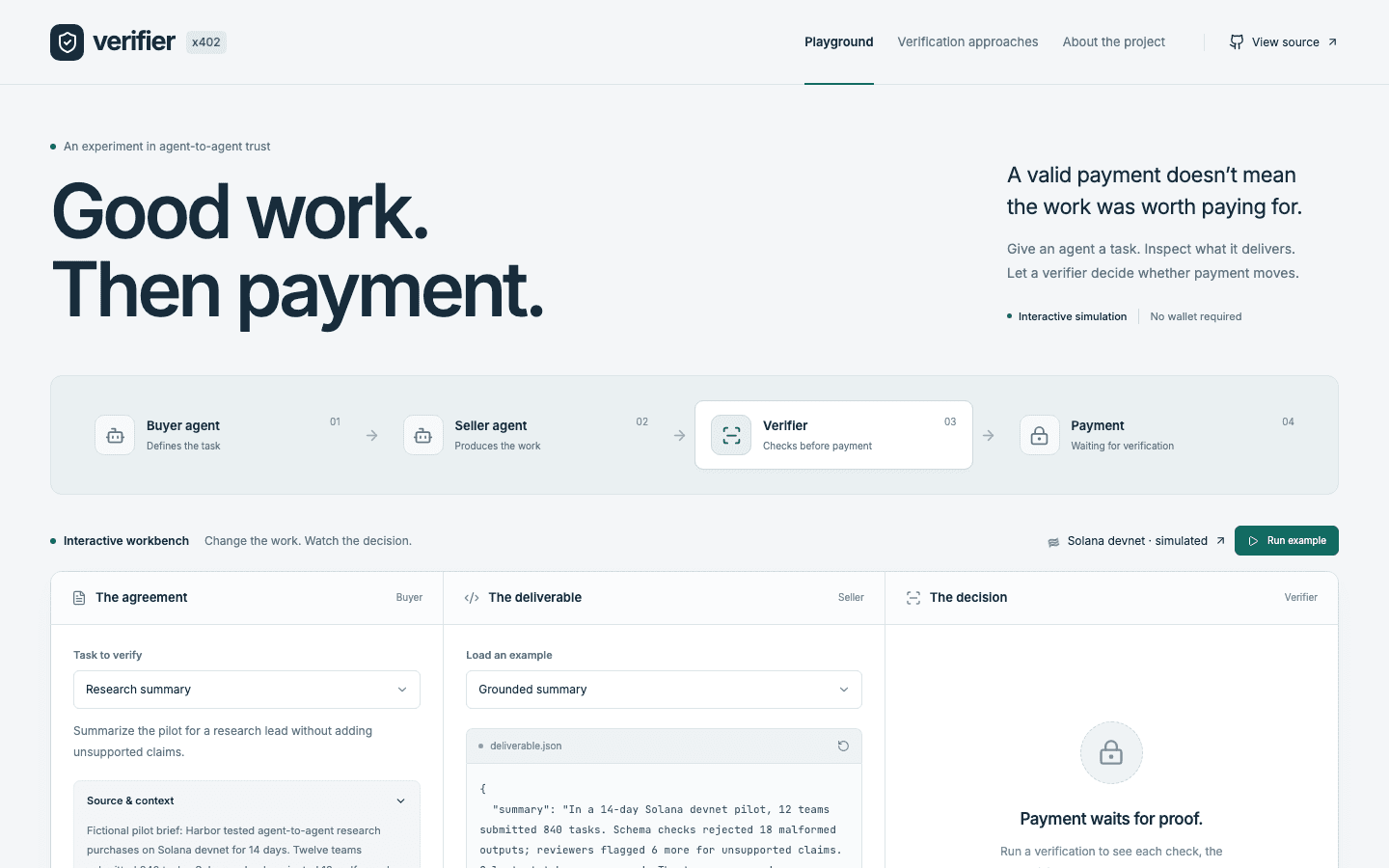
Check an agent's work before the x402 payment moves. Live Solana-devnet simulation: seven task types, stepped judge policies, disputes.
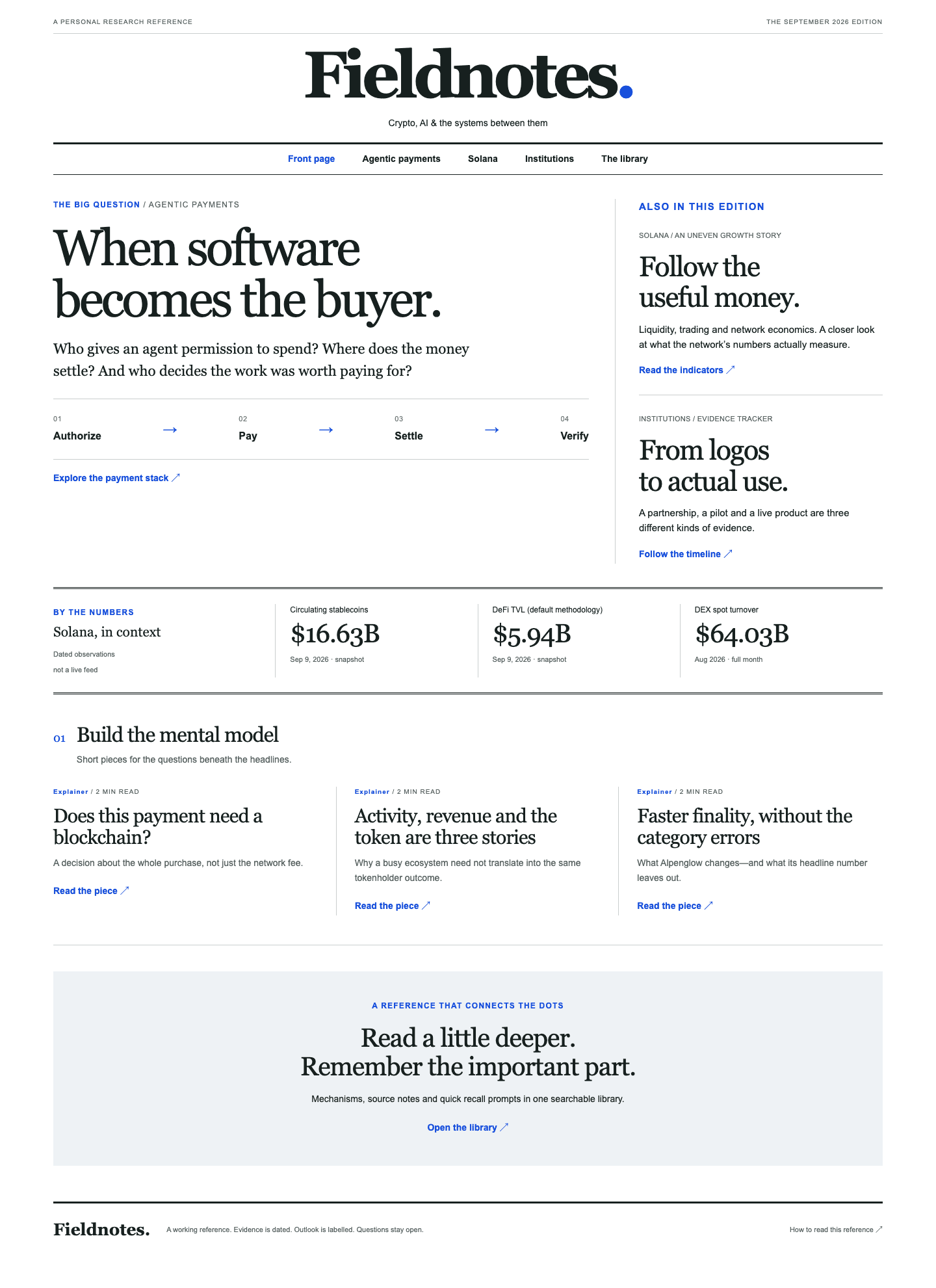
Editorial reference site on agentic payments, Solana liquidity and institutional adoption, with a day-gated data refresh and review flags.
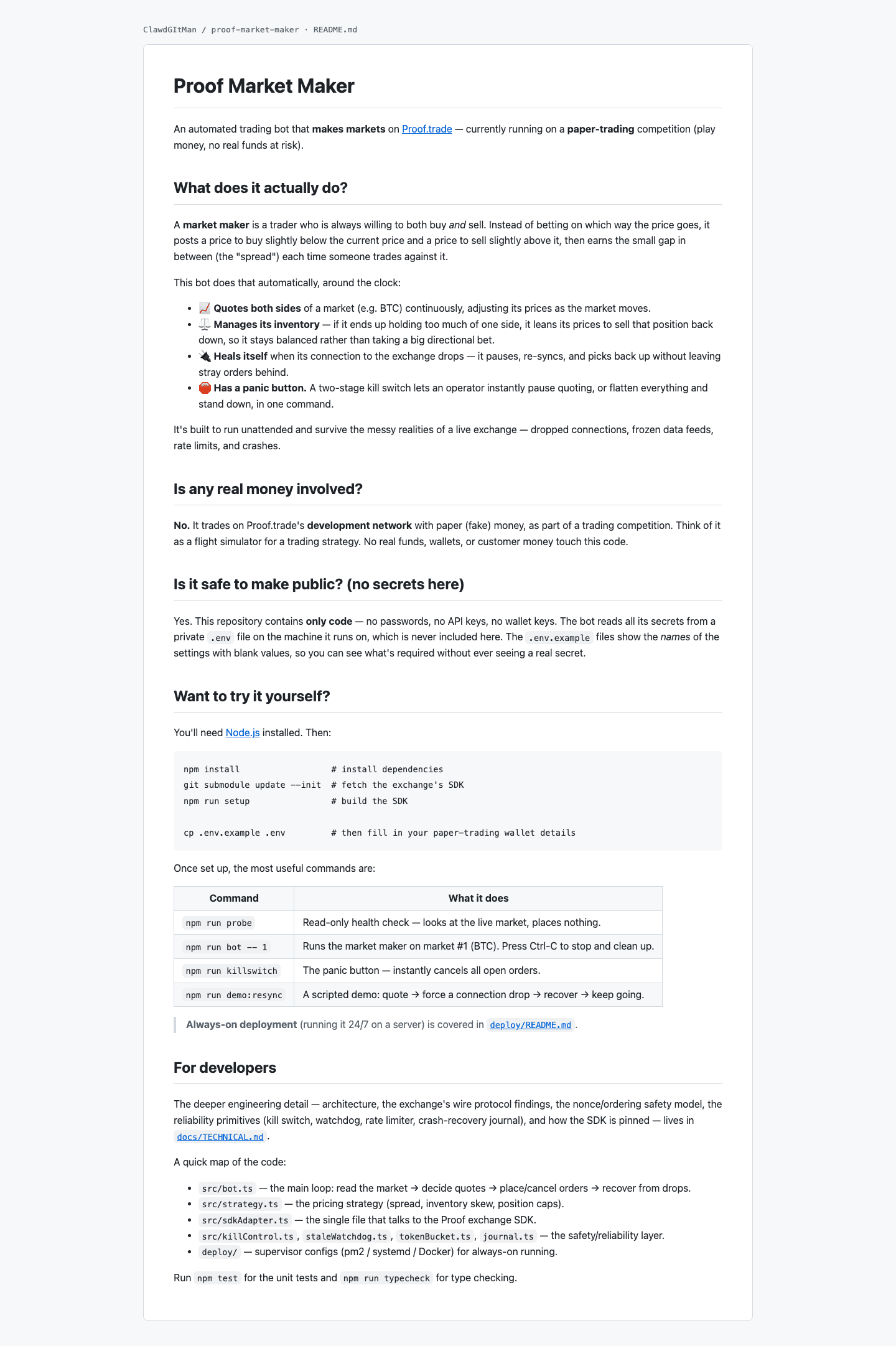
An always-on market-making bot with inventory control, self-healing reconnects and a two-stage kill switch, plus an operator dashboard.
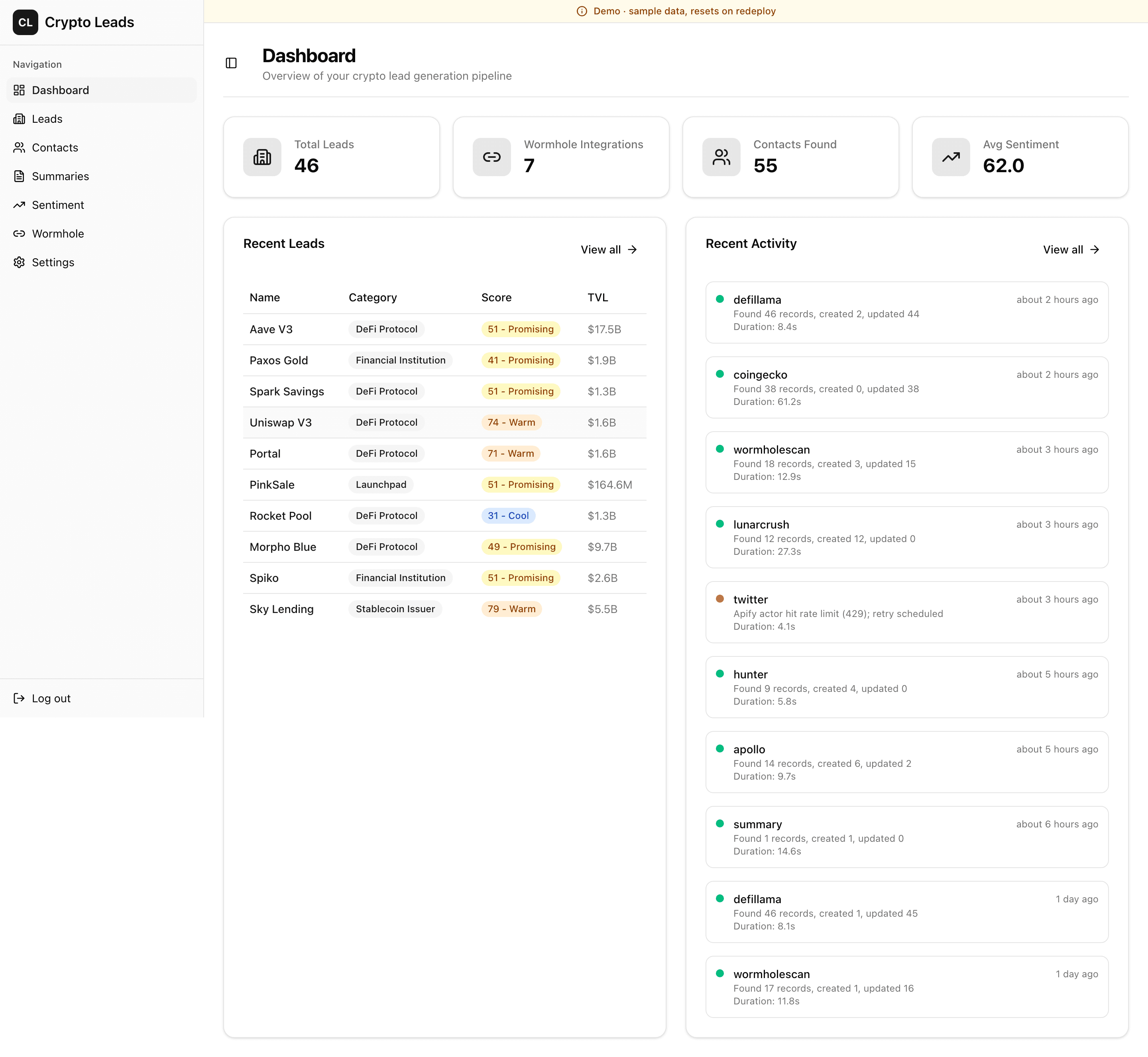
A lead-gen tool for cross-chain DeFi BD: protocol leads, Wormhole tracker, sentiment, AI briefings. Live demo, no login.
All 15 projects Products, experiments, and the ones that stalled.
Two positions on where crypto is headed, starting with the essay I published in April. Each opens with the 30-second version and closes with what would make me wrong.
A second economy is forming alongside the human one. It runs on agents, settles in stablecoins, and needs a verification layer nobody has built.
Agents will have an economy more diverse than the human one, made of specialists hiring specialists for cents at a time. Speed and cost are half the problem; the other half is proving the work was done. Without a verification layer that grades output and decides whether payment goes through, the whole thing runs on trust, and nothing runs on trust at fractions of a cent. Stablecoins and programmable rails are the only money that fits.
Read the essayDeFi is the era that stuck. The next phase is not more decentralized or more exciting. It is institutional, regulated, and pulled forward by tokenization.
Every crypto era has told us what the technology is for: ICOs, NFTs, memecoins came and went, DeFi stayed. Its usage survives the cycles even as TVL falls, but its flaw is unchanged: about $3.4B was stolen in 2025 and the blue chips (Drift, Aave) lost nine figures in single afternoons in April 2026. Perps, led by Hyperliquid, are where the excitement went. Tokenization is where the institutions went: $310B in stablecoins, $15B in tokenized Treasuries, Nasdaq cleared to trade tokenized stocks, JPMorgan past $300B of repo on tokenized collateral. Once a bank holds tokenized dollars and Treasuries, DeFi becomes the obvious place to put them to work. What gets us there is regulation and security, not more decentralization. The end state is that nobody asks whether their brokerage runs on a blockchain. They only care that it works better.
Read the essay