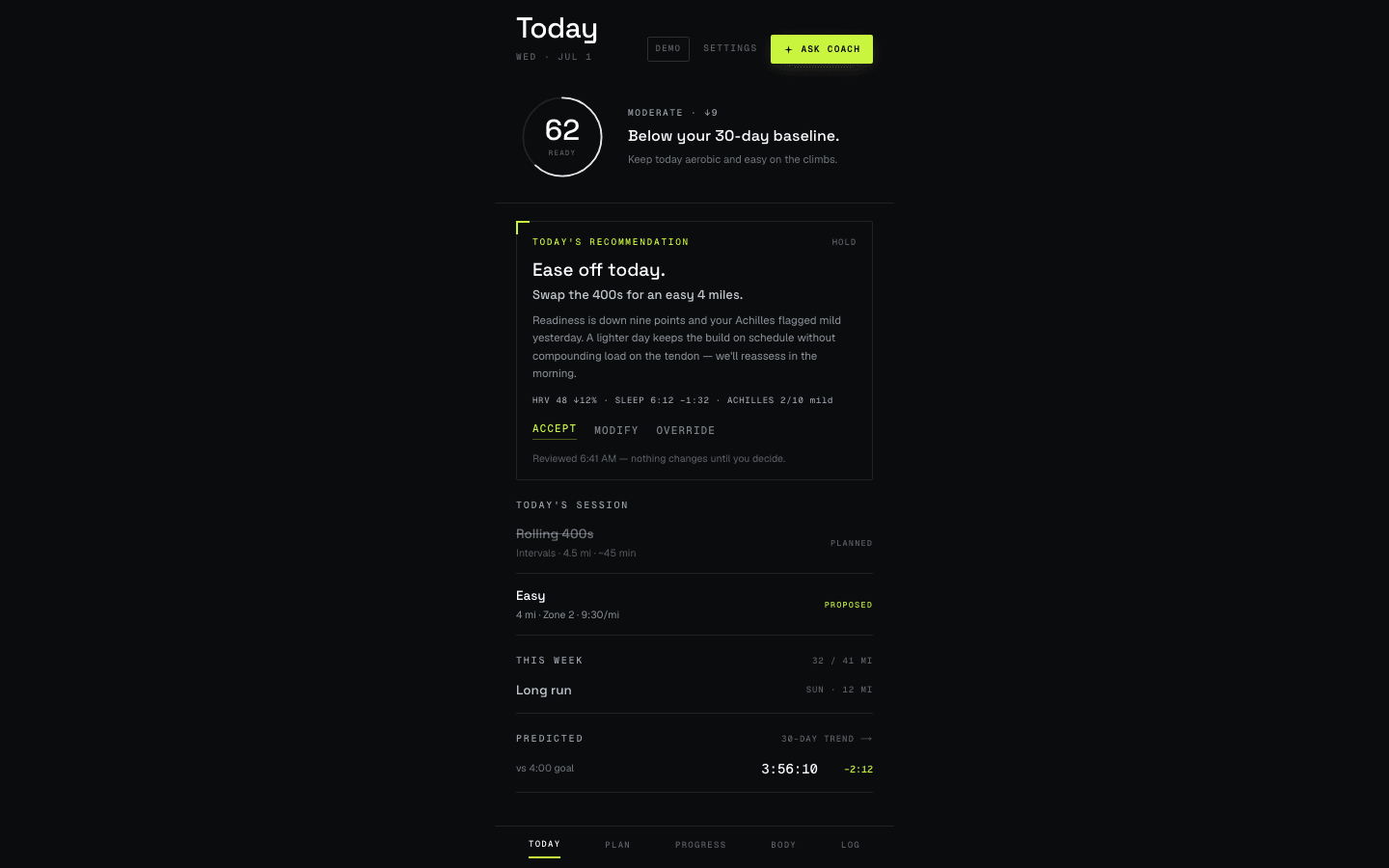
The Daily home screen in the Instrument design system: near-black graphite, hairline rules, one lime signal colour
Progress: weekly mileage, pace and recovery trends with tabular numerals
Plan: the training block by week with per-session-type accents
Log: synced Strava activities and Whoop recovery snapshots
01 · What I built
A training app I built for myself between 2026-07-01 and 2026-08-24, in 90 commits. Phase 1 was a localStorage prototype with the screens I wanted: Daily, Progress, Plan, Log, Strength and a workout-detail view. Phase 2 added a real Supabase backend with row-level security on every table, live Whoop and Strava sync (including Strava webhooks and token rotation), an encrypted token store, an offline shell via a service worker, and a morning cron that runs hourly but only fires when it is 6am in the profile's own timezone, so it survives daylight-saving changes.
On 2026-08-24 I added a public demo mode: a VIEW DEMO button signs visitors into a seeded demo account server-side, scoped by RLS to the demo rows only, and a reset script wipes visitor drift back to the clean seed. The test suite covers 42 Playwright end-to-end tests in local mode plus unit tests and stack-backed RLS parity suites.
02 · What I learned
The difference between a prototype and a product is the list of things that can go wrong: expired OAuth tokens that rotate on refresh, a webhook that has to be registered after deploy because its callback URL does not exist before, a cron that drifts with daylight saving, a service worker that would serve stale code in development. Each of those is documented in the README because each one bit me once.
I also learned that a demo mode is a product feature, not an afterthought. Making the app safely usable by strangers required the same RLS discipline as making it private.
03 · Built with AI
Designed first in a Claude Design handoff (the Instrument design system), then built by Claude Code against phase specs in the repo's docs. My checkpoints were physical: sign in on my phone, connect Whoop and Strava, airplane-mode the app and reopen it, watch the 6am briefing arrive. The security-sensitive surface is listed in a separate doc for a future human reviewer, which is how I flag code I have not read.